How to Troubleshoot Baby Safety Gate Installation Issues
Want this done properly without the hassle?
Aap DIY try kar sakte hain, lekin agar time nahi ya confidence kam ho, to professional bula lena better hota hai. Galat step se damage ya safety issue ho sakta hai.
Quick answer (read this first)
- Check gate alignment and levelness.
- Tighten all pressure mounts or hardware securely.
- Inspect hinges and latch mechanisms for proper function.
- Ensure the mounting surface is stable and suitable.
- Always refer to the gate’s specific instruction manual.
Safety first
- Always read the gate manufacturer’s instructions thoroughly before starting.
- Never leave a baby unsupervised near an unsecure or incorrectly installed gate.
- Ensure the gate is securely anchored to prevent tipping hazards.
- Avoid using damaged or broken gate components, replace them if necessary.
- Keep small parts and tools out of reach of children during installation.
Tools you may need
- Screwdriver set (Philips and flathead)
- Adjustable wrench or spanner
- Measuring tape
- Spirit level or smartphone leveling app
- Pencil for marking
- Original gate manual (if available)
Step-by-step
Step 1
Consult the Manual: Re-read your baby gate’s instruction manual to confirm proper assembly and part identification.
Step 2
Verify Alignment and Level: Use a spirit level to ensure mounting surfaces (doorframe or wall) are level. Adjust the gate’s position for correct alignment.
Step 3
Reinforce Pressure Mounts: For pressure gates, tighten all pressure pads evenly and firmly against the wall or frame until the gate is completely secure.
Step 4
Examine Hardware Fasteners: For hardware-mounted gates, check all screws, bolts, and wall anchors for tightness. Replace any stripped or loose fasteners immediately.
Step 5
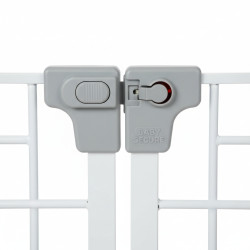
Test the Latch: Operate the gate’s latching mechanism repeatedly to confirm it closes and locks securely and smoothly without sticking.
Step 6
Check Gate Swing: Ensure the gate swings open and closes freely without obstruction and remains stable in its closed or open position.
Step 7
Adjust for Gaps: If uneven gaps exist, adjust tension rods or mounting hardware until the gate is centered and gaps are consistent and within safety limits.
Step 8
Conduct Final Security Check: Apply firm pressure to the top and bottom of the gate in all directions to confirm it does not move, flex, or come loose.
Common mistakes
- Not thoroughly reading the instruction manual before attempting installation.
- Overtightening pressure mounts, which can damage walls, or undertightening, leading to insecurity.
- Ignoring uneven surfaces or baseboards that interfere with proper gate alignment.
- Using a pressure-mounted gate at the top of stairs, which is unsafe.
- Assuming the gate is secure without performing comprehensive safety checks.
- Damaging walls or doorframes by using incorrect tools or forcing hardware.
When to call a professional
- If you encounter complex structural issues with your walls or doorframes that prevent secure installation.
- If the gate hardware appears damaged, incompatible with your home, or you’re missing critical parts.
- If you are unable to achieve a stable and secure installation after following all troubleshooting steps.
- If you require custom modifications for irregular openings that standard gates cannot fit.
- If you lack the necessary tools, experience, or confidence to complete the task safely and effectively.
Want this done properly without the hassle?
Aap DIY try kar sakte hain, lekin agar time nahi ya confidence kam ho, to professional bula lena better hota hai. Galat step se damage ya safety issue ho sakta hai.