How to do a basic Office Chair Wheel Replacement safety check and quick fixes
Want this done properly without the hassle?
Aap DIY try kar sakte hain, lekin agar time nahi ya confidence kam ho, to professional bula lena better hota hai. Galat step se damage ya safety issue ho sakta hai.
Quick answer (read this first)
- Regularly inspect wheels for wear and tear.
- Clean debris like hair and dust from casters.
- Tighten any loose wheel stems firmly.
- Lubricate sticky or squeaky wheels.
- Replace severely damaged wheels promptly for safety.
Safety first
- Always work on a stable, flat surface to prevent the chair from moving or tipping.
- Ensure the chair is fully stable before tipping it over to avoid injury.
- Wear gloves to protect your hands from grime, rust, and potentially sharp edges.
- Be mindful of pinch points when removing or installing wheels to prevent hand injuries.
- Avoid using excessive force, which can damage the chair’s base or the wheel’s socket.
Tools you may need
- Screwdriver (Phillips or flathead, depending on chair design)
- Pliers
- WD-40 or silicone spray lubricant
- Clean cloth or small brush (e.g., old toothbrush)
- Tweezers (optional, for removing hair)
- New replacement wheels (if severe damage is found)
Step-by-step
Step 1
Prepare Your Workspace: Move the office chair to a stable, flat surface. Carefully tip the chair onto its side or back to gain full, unobstructed access to all the wheels and their attachment points.
Step 2
Conduct a Thorough Visual Inspection: Examine each wheel and its housing meticulously. Look for obvious signs of damage such as cracks, chips, excessive wear, flat spots, or any foreign material like hair, thread, or dust wrapped around the axle.
Step 3
Clean All Casters: Using a clean cloth, small brush, or tweezers, carefully remove any accumulated debris, hair, or dust from around the wheel, its axle, and inside the caster housing. Ensure the wheel can spin freely after cleaning.
Step 4
Check for Loose Wheels: Gently pull and wiggle each wheel. If a wheel feels wobbly or excessively loose, it may indicate a loose stem or a worn socket. Make a note of these for the next steps.
Step 5
Lubricate Stiff or Squeaky Wheels: If a wheel is stiff, squeaks, or doesn’t rotate smoothly, apply a small amount of WD-40 or silicone spray lubricant directly to the axle point where the wheel meets its housing. Rotate the wheel several times to distribute the lubricant.
Step 6
Attempt to Tighten Loose Wheel Stems: For wheels identified as loose, if they are screw-in casters, try tightening any visible retaining screw. For push-in casters, attempt to firmly push the stem back into its socket. If it continues to wobble, the socket might be damaged.
Step 7
Identify Wheels for Replacement: After cleaning, lubrication, and tightening attempts, if a wheel is still cracked, broken, severely worn (e.g., flat spots), or remains excessively loose and wobbly, it is beyond a quick fix and requires replacement.
Step 8
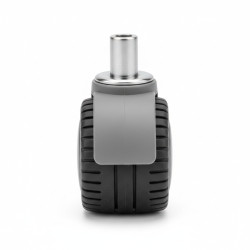
Replace Damaged Wheels (If Necessary): To replace push-in caster wheels, firmly grip the old wheel and pull it straight out of the chair base. Then, align the stem of the new replacement wheel with the socket and push it in firmly until it clicks securely into place.
Common mistakes
- Ignoring minor squeaks or stiffness, which can lead to greater damage and potential safety hazards over time.
- Using incompatible replacement wheels that do not fit the chair base properly, leading to instability.
- Forgetting to thoroughly clean all debris from the wheel axles and housing before attempting fixes.
- Applying too much lubricant, which can attract more dust and dirt, worsening the problem in the long run.
- Not ensuring the chair is completely stable before attempting any repairs, risking injury or further damage.
When to call a professional
- If the chair’s base or the wheel’s socket is cracked, stripped, or severely damaged, requiring structural repair.
- If wheels are stuck firmly in place and cannot be removed without excessive force, risking damage to the chair.
- If you lack the necessary tools or cannot find suitable, compatible replacement parts for your specific chair model.
- If the chair feels unstable or unsafe even after attempting all quick fixes and potential wheel replacements.
- When multiple wheels are severely damaged or the problem persists after your best efforts, indicating a more complex issue.
Want this done properly without the hassle?
Aap DIY try kar sakte hain, lekin agar time nahi ya confidence kam ho, to professional bula lena better hota hai. Galat step se damage ya safety issue ho sakta hai.