How to Troubleshoot & Fix Office Chair Wheel Replacement Issues at Home
Want this done properly without the hassle?
Aap DIY try kar sakte hain, lekin agar time nahi ya confidence kam ho, to professional bula lena better hota hai. Galat step se damage ya safety issue ho sakta hai.
Quick answer (read this first)
- Verify wheels are fully and correctly inserted.
- Confirm all new wheels are compatible and identical.
- Check for debris or obstructions in the wheel mechanism or socket.
- Apply appropriate lubricant if wheels are stiff or squeaky.
- Ensure the chair base sockets are undamaged and secure.
Safety first
- Always work on a flat, stable surface to prevent the chair from tipping.
- Wear gloves to protect your hands from grease, grime, or sharp edges.
- Be mindful of pinching fingers when installing or removing wheels.
- Do not force components; excessive force can cause damage to the chair or wheels.
- Ask for help if the chair is heavy or awkward to maneuver, especially when turning it upside down.
Tools you may need
- Screwdriver (Phillips or flathead, if needed for certain chair models)
- Pliers (for stubborn debris or old wheel stems)
- Rubber mallet (optional, for gentle persuasion during re-insertion)
- Lubricant spray (e.g., silicone spray, WD-40, specifically for plastics/metals)
- Clean cloth or brush (for cleaning sockets and wheel mechanisms)
- Flashlight (to inspect dark areas inside sockets)
- Thin, blunt tool (e.g., a dental pick or small pry tool for debris removal)
Step-by-step
Step 1
Step 1: Initial Assessment of the Problem: Turn the office chair upside down on a stable, non-slip surface. Carefully examine all wheels and their respective sockets. Identify the specific issue: Is a wheel stuck, wobbling excessively, falling out, or is the entire chair unstable? Look for any visible damage to the wheels or the chair base.
Step 2
Step 2: Verify Proper Wheel Insertion: For each wheel, firmly push it up into its socket on the chair base until you hear or feel a secure click. Ensure there are no visible gaps between the wheel stem and the chair’s base socket. Gently pull on each wheel to confirm it is seated tightly and doesn’t easily come loose.
Step 3
Step 3: Inspect for Debris and Obstructions: Using a flashlight, closely examine the inside of the wheel sockets on the chair base for any remnants of old wheels, dirt, hair, or other debris that might prevent the new wheel from seating correctly. Also, inspect the wheel axles and housing for trapped hair or foreign objects. Use a thin tool or pliers to carefully remove any obstructions found.
Step 4
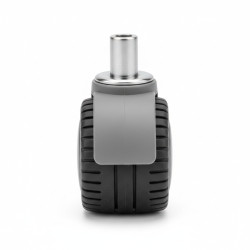
Step 4: Check Wheel Compatibility and Type: Confirm that all installed wheels are the correct type and size for your chair model. Mismatched wheel stem diameters, lengths, or wheel materials (e.g., hard vs. soft floor casters) can lead to uneven rolling, instability, or poor fit. Ensure all replacement wheels are identical.
Step 5
Step 5: Address Stiffness or Squeaking: If a wheel is stiff, difficult to rotate, or squeaks, carefully remove it from its socket. Apply a small amount of lubricant spray (like silicone spray, ensuring it’s safe for plastics) onto the wheel stem and sparingly inside the chair’s socket. Reinsert the wheel, rotate it manually to distribute the lubricant, and then test its movement.
Step 6
Step 6: Examine Chair Base Sockets for Damage: If wheels continue to be loose, fall out, or the chair remains unstable, inspect the plastic or metal sockets on the chair base. Look for any cracks, enlarged openings, or stripped areas that might prevent the wheel stem from seating properly. Damage to the base often requires professional attention or a replacement chair base.
Step 7
Step 7: Test Chair Stability and Movement: Once all troubleshooting steps have been performed, turn the chair upright. Sit on it and test its movement on a flat, hard surface. Roll it forward, backward, and in circles to ensure all wheels move freely and the chair feels stable and secure. Re-evaluate if the initial problem persists or if any new issues have emerged.
Common mistakes
- Using incompatible wheel stems or wheel types (e.g., wrong diameter, incorrect caster type for your flooring) for your specific chair model.
- Failing to fully insert the new wheel stem into the chair’s socket, leading to wobbling or the wheel falling out.
- Not thoroughly cleaning old debris, dirt, or hair from the chair’s wheel sockets before inserting new wheels.
- Ignoring existing damage to the chair base sockets during the initial replacement or troubleshooting process.
- Applying too much lubricant, which can attract more dirt and grime over time, or using a lubricant that damages plastic components.
When to call a professional
- If the chair’s base sockets are visibly damaged, cracked, or stripped, and cannot hold the wheels securely.
- If new wheels consistently fall out or become loose despite being correctly inserted and troubleshooting attempts.
- If the chair remains unstable or unsafe to use even after attempting all recommended troubleshooting steps.
- If you suspect internal damage to the chair’s mechanism or frame beyond just the wheels.
- When you lack the appropriate tools, expertise, or feel uncomfortable performing the repair safely at home.
Want this done properly without the hassle?
Aap DIY try kar sakte hain, lekin agar time nahi ya confidence kam ho, to professional bula lena better hota hai. Galat step se damage ya safety issue ho sakta hai.